
Proxycurl Is Gone: Best LinkedIn Data API Alternatives in 2026 (and How to Migrate)
Proxycurl, for years one of the most popular LinkedIn data APIs, shut down in 2025 after LinkedIn sued the company behind it. If your pipeline broke overnight, this guide gives you the accurate story (the dates and the case, not the rumors), the real lesson for choosing your next vendor, an honest comparison of the live alternatives by model, and a concrete migration path. No gloating, no single-product hard sell – just what happened and what to do next.
The short version. For a like-for-like "profile URL in, JSON out" replacement, a real-time scraper (ScrapIn, Apify, Bright Data) is the closest drop-in. For bulk enrichment, a dataset provider (Coresignal, People Data Labs) fits. If you want live data plus the ability to act – and no shared scraped database that a court can order deleted – an account-based API (Linked API, Unipile) is the durable play. The thing that actually killed Proxycurl – fake accounts and a central scraped index – is the thing not to repeat.
What happened to Proxycurl
On January 24, 2025, LinkedIn sued the company behind Proxycurl (Nubela) in the U.S. District Court for the Northern District of California – LinkedIn Corp. v. Nubela Pte. Ltd., No. 3:25-cv-00828 (N.D. Cal.), filed January 24, 2025; see the docket. The complaint brought six claims, including breach of contract, fraud and deceit, violation of the Computer Fraud and Abuse Act (CFAA), California's Unfair Competition Law, a Lanham Act claim, and misappropriation.
The core allegation was not simply "they used LinkedIn data." It was that Proxycurl created hundreds of thousands of fake accounts to scrape millions of profiles, including non-public data, and resold that data through its API. The case settled in mid-2025; Proxycurl posted its goodbye in July 2025 and wound the service down, with customers notified and data slated for deletion.
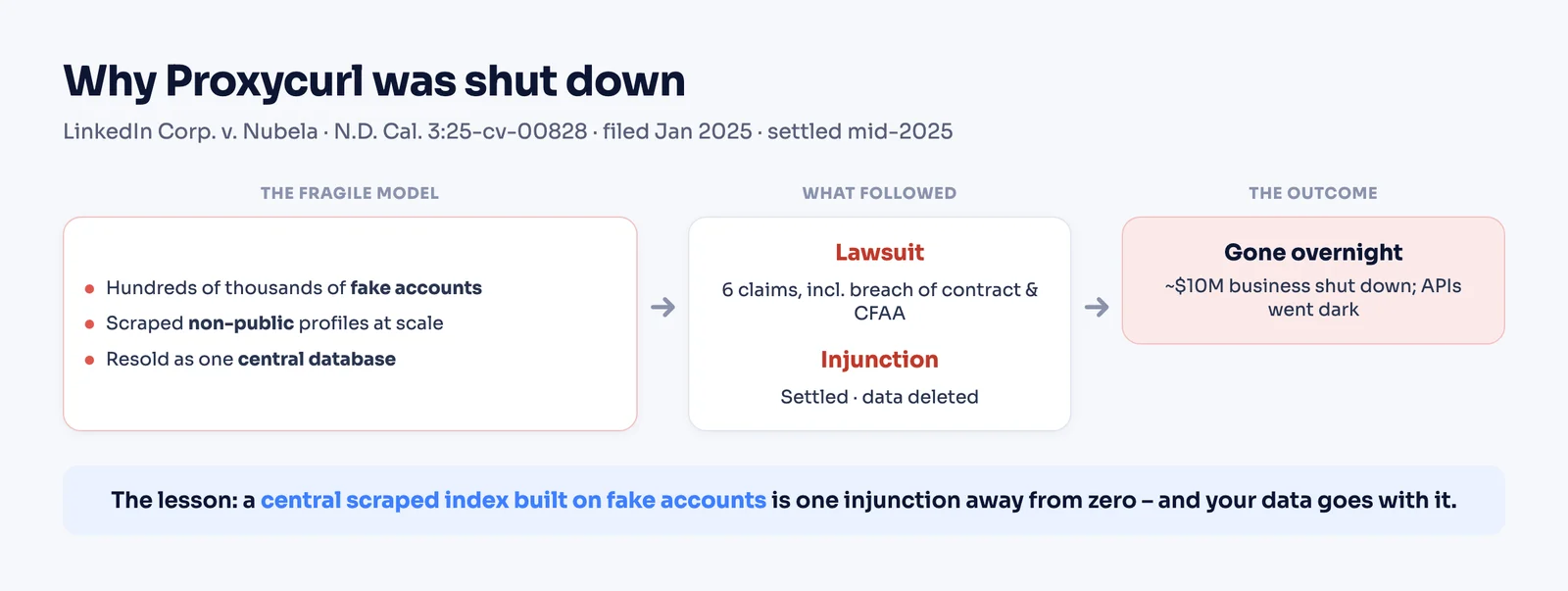
To its credit, Proxycurl's founder was candid afterward. He wrote in his July 2025 goodbye post that the business was a roughly $10M revenue business, that about half of it came from scraping LinkedIn, and that there was "no winning in fighting this" against a company with an effectively unlimited legal budget. The team has since pivoted to a new product, NinjaPear, that explicitly does not scrape LinkedIn.
The real lesson for picking your next API
It is tempting to read this as "LinkedIn data is radioactive, stay away." That is the wrong takeaway. The fatal combination was specific: fake accounts at scale, scraping non-public data, packaged as a central database and resold. Each of those is a separate aggravating factor, and together they made the case easy to bring.
The legal backdrop is more nuanced than the headlines. Scraping genuinely public data is not automatically illegal in the US – that is the takeaway from hiQ Labs v. LinkedIn. But the moment you spin up fake accounts or reach non-public data at scale, you are in CFAA and privacy-law territory. (We cover the full legal model in our guide to scraping LinkedIn.)
For you as a buyer, the practical lesson is about continuity risk. A provider whose entire business is a central, scraped index of LinkedIn is one injunction away from gone – and that injunction can require deleting the very data you depend on, with little notice. Vendor selection now has to weigh "will this still exist, and will my data survive, in twelve months?" alongside price and coverage.
The live alternatives, by model
Proxycurl's competitors – the LinkedIn data APIs still standing – split into three models. Most "Proxycurl alternative" listicles blur them together and then crown whichever product the author sells. Here they are honestly, with the trade-offs that matter.
| Model | How it works | Closest Proxycurl match | Examples | Freshness | Risk sits with | Typical price |
|---|---|---|---|---|---|---|
| Real-time scraper | Pass a URL, scraped live via proxies | Person/Company Profile endpoints | ScrapIn, Apify, Bright Data, Scrapingdog | Live | The provider | ~$1.50–$4 / 1K profiles |
| Dataset / database | Query a pre-scraped database in bulk | Search and bulk enrichment | Coresignal, People Data Labs, Crustdata | Months to years | The data holder | ~$0.005–$0.20 / record |
| Account-based API | Runs your own authenticated account | Profile reads, plus actions | Linked API, Unipile | Live | Your account | Flat per connected account |
Real-time scrapers are the closest drop-in for Proxycurl's bread-and-butter "give a profile URL, get JSON." ScrapIn (now merged into Reverse Contact) and Apify's LinkedIn actors are the usual developer picks; Bright Data is the enterprise-scale option with the strongest legal track record. You hand over a URL, they manage proxies and return structured data – and they carry the scraping risk.
Dataset providers like Coresignal and People Data Labs sell scale: hundreds of millions of records you can query or buy in bulk. They replace Proxycurl's search and enrichment use case, not real-time single lookups, and the trade-off is freshness – records are often months or years out of date between refreshes. Crustdata sits in this group too: it indexes public web pages into one graph of people and companies, served through a REST API and an MCP server with flat-file datasets alongside, and it publishes no prices – real-time retrieval is an enterprise-tier option there rather than the default.
Account-based APIs work differently: they drive your own authenticated LinkedIn account in a cloud browser. There is no shared scraped index for a court to seize, and you can act (connect, message, react), not just read. The honest caveat: the risk shifts to your account and LinkedIn's terms, and throughput is bounded by your account's daily limits – it is not a bulk firehose. This is the account-based model we build at Linked API.
What replaced the Proxycurl API?
Nothing replaced the Proxycurl API one-for-one, and the team behind it is not the answer either: Nubela's new product, NinjaPear, deliberately does not touch LinkedIn. So the 21-odd endpoints you were calling now split across three kinds of product, and which one you want depends on the endpoint.
Here is where each one goes:
| Proxycurl endpoint | What it did | Where to go now |
|---|---|---|
| Person Profile / Person Lookup | Profile data from a URL | Real-time scraper (ScrapIn, Apify, Bright Data) or account-based fetchPerson |
| Person Search / Role Lookup | Find people by criteria | Dataset search (Coresignal, PDL) or account-based people search |
| Company Profile / Employee Count | Company firmographics | Dataset (Coresignal) or account-based company data |
| Employee Listing / Search | Roster of a company's people | Dataset, or account-based company fetch with employees |
| Job Listing / Job Search | LinkedIn job posts and job search results | Account-based job search and job data – searchJobs and fetchJob in the Node and Python SDKs – or a dataset provider |
| Work Email / Reverse Email / Personal Contact | Contact details | Consented enrichment (Reverse Contact, People Data Labs, Prospeo) |
| Credit Balance | How much quota you had left | Nothing to port on a flat per-seat plan; the equivalent check is API usage statistics |
One honest note on contact data: the email and phone endpoints were always the legally hottest part of Proxycurl. Personal contact details are not something you should extract from LinkedIn directly – source them from a consented B2B enrichment provider instead. We explain why in the scraping guide.
Proxycurl pricing, and what the replacements cost
Proxycurl sold credits, and its pricing page is still published even though the service is gone. The monthly tiers were Starter $49 for 2,500 credits at $0.020 a credit, Growth $299 for 25,000 at $0.012, Pro $899 for 89,900 at $0.010, and Ultra $1,899 for 211,000 at $0.009, with an Enterprise tier from $2,000 above that (per Proxycurl's own pricing page).
Replacements do not price in the same unit, which is the part that makes a like-for-like comparison misleading. Real-time scrapers charge roughly $1.50–$4 per 1,000 profiles, so they behave most like the credit model you are leaving. Dataset providers charge per record, from fractions of a cent to about $0.20, and expect volume. Account-based APIs charge per connected account and meter nothing: Linked API is $49 per seat per month billed annually, the same headline number as Proxycurl's entry tier, but it buys a different thing – no credit balance to watch, and throughput bounded by one LinkedIn account's safe daily pace rather than by a quota you can top up.
Migrating to an account-based API
If you used Proxycurl for live profile reads and want control rather than a shared index, the account-based path maps cleanly. The Person Profile endpoint – a URL in, structured JSON out – becomes a single call against your own account. Install the SDK:
# Node.js
npm install -S @linkedapi/node

# Python
pip install linkedapi
Then fetch a profile by URL, the direct analog of Proxycurl's Person Profile endpoint:
import LinkedApi from '@linkedapi/node';

const linkedapi = new LinkedApi({
  linkedApiToken: process.env.LINKED_API_TOKEN,
  identificationToken: process.env.IDENTIFICATION_TOKEN,
});

const profile = await linkedapi.fetchPerson.execute({
  personUrl: 'https://www.linkedin.com/in/jane-doe',
  retrieveExperience: true,
  retrieveSkills: true,
});

const { data } = await linkedapi.fetchPerson.result(profile.workflowId);
console.log(data?.name, data?.position, data?.followersCount);The same execute then result pattern covers people search and company data. Grab your tokens from the installation guide to start.
A one-day migration checklist
- Put a thin interface in front of your data source so you can swap providers without touching the rest of the app. Proxycurl taught everyone why this matters.
- Pick a model by job: live single-profile reads to a real-time scraper, bulk firmographics to a dataset, your-own-account reads plus actions to an account-based API.
- Map your fields. Most providers return the same core profile shape; normalize names once at the boundary.
- Move contact lookups to consented enrichment rather than direct extraction.
- Backfill any records you lost when Proxycurl went dark.
- Handle limits. Real-time and dataset APIs have rate limits; account-based APIs surface a limit error when you would exceed your account's safe pace.
Frequently Asked Questions (FAQ)
LinkedIn sued the company behind Proxycurl in January 2025 over creating fake accounts to scrape profiles, including non-public data, and reselling it. The case settled in mid-2025, and Proxycurl wound the service down. Its founder said about half the revenue came from LinkedIn scraping, and that there was "no winning in fighting this."
No. Its founder put it plainly in an April 2026 post: "Proxycurl is shut down. Old docs, old blog posts, and old code samples still exist. Treat them as historical reference only." The same post answers whether the team's new product is a direct replacement with a flat "No" – NinjaPear does not scrape LinkedIn – so for LinkedIn data specifically the choice is between the three models above.
There is no single answer – it depends on the job. For "profile URL in, JSON out," a real-time scraper like ScrapIn or Apify is the closest drop-in. For bulk enrichment, Coresignal or People Data Labs. For live data plus actions on your own account, an account-based API like Linked API.
Real-time scrapers (ScrapIn, Apify, Bright Data, Scrapingdog) and account-based APIs both take a profile URL and return structured JSON. Dataset providers work by query and bulk export instead.
Scraping genuinely public data is not automatically a crime in the US under hiQ v. LinkedIn, but it still falls under LinkedIn's terms and under GDPR and CCPA for personal data. Fake accounts and non-public data are what turn it into a lawsuit. See our legal breakdown.
The risk depends on the model. A provider built on a fake-account farm and a central scraped index carries the same exposure Proxycurl did. A dataset or real-time provider that sources data carefully spreads that risk, and an account-based API moves it onto your own account and LinkedIn's terms rather than a shared index. None of these is risk-free; choose with that in mind.
Proxycurl was credit-based, from $0.020 a credit on its $49 Starter tier down to $0.009 at volume. Real-time scrapers run about $1.50–$4 per 1,000 profiles, datasets from fractions of a cent to ~$0.20 per record, and account-based APIs charge a flat rate per connected account – the tier-by-tier comparison is above.
Abstract your data source behind an interface, pick a replacement model by use case, map your fields, move contact lookups to consented enrichment, and backfill lost records. Most profile shapes are similar enough that the swap is a boundary-layer change, not a rewrite.
Were you using Proxycurl for live profile reads and the ability to act? Linked API runs your own authenticated account and returns clean JSON for people, companies, posts, and search – with no shared scraped database to disappear overnight.