
8 Best Waalaxy Alternatives in 2026 (Compared by Use Case)
Waalaxy is one of the easiest ways to start LinkedIn outreach – a clean visual builder that runs connection requests, messages, and follow-ups (with cold email on its top tier) from the cloud, priced per seat and metered by credits. People look for an alternative when they hit its edges: invitation and credit caps that push you to upgrade, per-seat pricing that multiplies across a team, multichannel and real inbox management locked to the most expensive plan, account-safety worries, and – for anyone technical – an API that only enrolls prospects into Waalaxy's own campaigns rather than exposing LinkedIn actions. The right replacement depends on which edge you hit. This guide matches each use case to the right tool, honestly, including where Waalaxy is still the better pick.
The short version. Worried about getting restricted? Expandi, for its dedicated IP and warm-up. Running many accounts for an agency? HeyReach. Want the same plug-and-play drip, different builder? Dripify. True multichannel across LinkedIn, email, and X? La Growth Machine, or lemlist if email is your main channel. Conditional logic without code? Skylead. Need a contact database? Kaspr. But notice that every one of those is another no-code campaign UI. Waalaxy does now ship an API and MCP server, yet they only enroll prospects into Waalaxy's own campaigns – not the LinkedIn actions themselves. If you have outgrown the fixed builder and want to build your own LinkedIn automation into a product, backend, CRM, or AI agent, you do not need another UI – you need an API like Linked API.
Pick your alternative in 30 seconds
| Tool | Best for | Channels | No-code UI vs API | Pricing model |
|---|---|---|---|---|
| Waalaxy (baseline) | Easy, affordable LinkedIn + email outreach | LinkedIn + email | No-code UI (API = campaign intake only) | Per seat (credit-metered) |
| Linked API | Building custom automation into your product or agent | API, SDK, CLI | Flat per seat | |
| Expandi | Safety-first outreach (dedicated IP + warm-up) | LinkedIn + email | No-code UI + Open API | Per account |
| HeyReach | Agencies running many accounts | No-code UI (API on all paid tiers) | Per sender | |
| Dripify | Plug-and-play drip campaigns | LinkedIn + email | No-code UI (reporting API, Pro and up) | Per seat |
| La Growth Machine | True multichannel outreach | LinkedIn + email + X | No-code UI | Per identity |
| lemlist | Email-first outreach with deliverability | Email + LinkedIn | No-code UI | Per seat |
| Skylead | Smart sequences with conditional logic | LinkedIn + email | No-code UI | Per seat |
| Kaspr | A contact database plus outreach | LinkedIn + email | No-code UI (API) | Freemium + per seat |
Prices and tiers change often; figures below are approximate as of 2026 and drawn from each vendor's own pricing pages, so check them for current numbers.
Why teams look for a Waalaxy alternative
Waalaxy is good at what it does. The reasons people switch are about its limits, not its quality.
- Invitation and credit caps. Waalaxy meters usage per plan – roughly 300 LinkedIn invitations a month on the Pro tier (€19 a month billed annually) and 800 on Advanced and Business, per Waalaxy's pricing page, 2026 – so heavy senders hit the ceiling and get pushed to upgrade.
- Per-seat pricing multiplies. Each seat is its own subscription – €39 to €139 per user per month on monthly billing, or €19 to €69 with the roughly 50% annual discount paid upfront, per Waalaxy's pricing, 2026 – so the bill scales linearly with headcount.
- Multichannel is a top-tier feature. Cold email and multichannel LinkedIn-plus-email sequences only appear on the €69 Business tier; the lower Pro and Advanced tiers are LinkedIn-led. If you want cross-channel from day one, you are already on the most expensive plan.
- Account-safety worries. Like any tool that automates LinkedIn, Waalaxy can get an account restricted. It runs from the cloud, but not getting flagged still comes down to conservative, human-paced activity – which safety-first tools make their whole pitch.
- The API only feeds Waalaxy. Waalaxy added an official API and MCP server in 2026, but they read your lists and campaigns and import prospects into Waalaxy's own campaigns. They do not let you run LinkedIn actions – search, profile data, connections, messages – from your own code.
- It is one fixed UI among many. Every mainstream alternative is the same shape – a no-code campaign builder – so switching often just trades one set of constraints for another.
Waalaxy's API only feeds Waalaxy – a programmable LinkedIn API is different
Here is the distinction most of these comparisons miss. Waalaxy is a no-code campaign product, and its 2026 API and MCP server do not change that. Per Waalaxy's own developer docs, the API lets you list your prospect lists (GET /prospectLists/getProspectLists), list your campaigns (GET /campaigns/getAll), and import a prospect into a list or campaign (POST /prospects/addProspectFromIntegration); the MCP server exposes the same intake actions (get-prospectlists, get-campaigns, add-prospects-to-list-campaign). It is a pipe that pushes prospects into Waalaxy's campaign engine – the automation still runs inside Waalaxy, on its fixed sequence model.
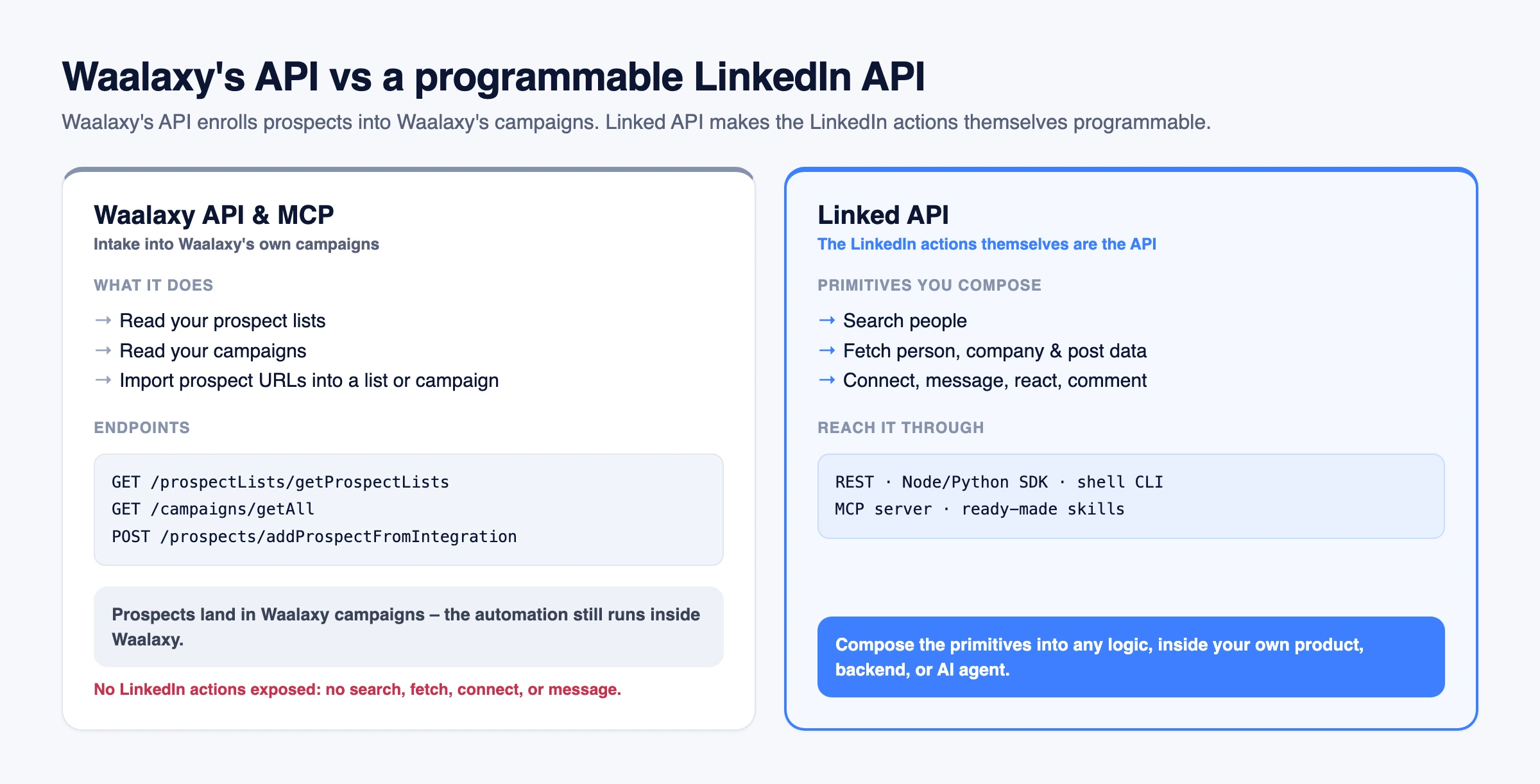
An API like Linked API is a different category. Instead of enrolling prospects into someone else's campaign, the LinkedIn actions themselves are the API: you get primitives – search people, fetch profiles, companies, and posts, connect, message, react, comment – and you compose them into whatever logic you want, in your own code. Branch on a real profile field, pull data from your CRM mid-flow, trigger from your app: things a fixed campaign builder cannot express. Reach them through a REST API, the Node and Python SDKs, or a shell CLI, and hand the same engine to an AI agent through the MCP server, the AI-agent-friendly CLI (Claude Code, Cursor, Codex), or ready-made skills.
import LinkedApi from '@linkedapi/node';

const linkedapi = new LinkedApi({
  linkedApiToken: process.env.LINKED_API_TOKEN,
  identificationToken: process.env.IDENTIFICATION_TOKEN,
});

const search = await linkedapi.searchPeople.execute({
  term: 'head of growth',
  filter: { locations: ['United States'] },
});
const { data: people } = await linkedapi.searchPeople.result(search.workflowId);

for (const person of people ?? []) {
  // Branch on a real profile field - your rule, not a fixed template
  const profile = await linkedapi.fetchPerson.execute({ personUrl: person.publicUrl });
  const { data } = await linkedapi.fetchPerson.result(profile.workflowId);
  if (!data || (data.followersCount ?? 0) < 1000) continue;

  const req = await linkedapi.sendConnectionRequest.execute({
    personUrl: person.publicUrl,
    note: `Hi ${person.name.split(' ')[0]}, loved your growth work, let's connect.`,
  });
  await linkedapi.sendConnectionRequest.result(req.workflowId);
}If a standard drip campaign is all you need, this is more than you want and a UI is simpler. If your automation has real logic, or belongs inside your product, an API is the right primitive.
The 8 best Waalaxy alternatives
Linked API – best for building custom automation into your own product
This is our tool, and the honest scope is that it solves a different problem than Waalaxy. It is a flexible LinkedIn automation API: you compose your own automation from primitives – search people, read profiles, companies, and posts, and act (connect, message, react, comment) – and embed it directly in your product, backend, CRM, or workflow, instead of arranging steps in a campaign UI. And you can use it both ways, each first-class: build it in through a clean REST API, the Node and Python SDKs, or a shell CLI – or get it out of the box by handing the same engine to an AI agent via the MCP server, the AI-agent-friendly CLI (Claude Code, Cursor, Codex), or ready-made skills, with nothing to wire up.
It runs through your own account in a cloud browser paced like a human, on flat per-seat pricing (from $49/mo billed annually), bounded by your account's daily limits. No automation is risk-free, so we do not claim zero ban risk. Best for developers and teams who have outgrown a fixed campaign builder and want LinkedIn data and actions inside their own systems. See how the model works in our LinkedIn scraper API guide.
Expandi – best for account safety
Expandi is the go-to when not getting restricted is your first concern. It runs cloud-based LinkedIn outreach with a dedicated country-specific IP per account and a structured warm-up that ramps activity gradually – the formalized safety layer Waalaxy does not match – at around $99 per account per month on monthly billing ($79 annual), per Expandi's pricing, 2026. It is outreach-focused like Waalaxy, just built around safety, and the per-account price adds up across a team. For the two safety designs side by side, see Linked API vs Expandi.
HeyReach – best for agencies and many accounts
HeyReach is built for the scenario where per-seat pricing hurts most: running outreach across dozens of LinkedIn accounts. It rotates senders, unifies inboxes, and pools limits across accounts, with per-sender pricing and an API on all plans, per HeyReach's pricing, 2026. For agencies and large SDR teams, it is purpose-built for multi-account scale in a way Waalaxy is not.
Dripify – best for plug-and-play drip campaigns
If what you like about Waalaxy is the simple visual sequence but you want a different builder, Dripify is the closest like-for-like: a clean drag-and-drop campaign editor that sends connections, messages, and follow-ups from the cloud, with LinkedIn and email steps. It is priced per seat in a similar range and, like Waalaxy's core product, is a no-code app rather than a developer API – its API, added in September 2026, reports on campaigns rather than acting on LinkedIn, alongside Zapier, Make, and webhooks – per Dripify's pricing and docs, 2026. We compare it and its rivals in our Dripify alternatives guide.
La Growth Machine – best for true multichannel
If you want outreach that spans LinkedIn, email, and X with deeper enrichment rather than the multichannel Waalaxy reserves for its top tier, La Growth Machine is the strongest multichannel pick, priced per identity, with X reserved for its top tier, per La Growth Machine's pricing, 2026. It is built cross-channel from the ground up, aimed at teams running genuinely multichannel campaigns.
lemlist – best for email-first outreach
lemlist comes at outreach from the email side, with strong deliverability tooling – warm-up, custom domains, spintax – plus LinkedIn steps layered on. If email is your primary channel and LinkedIn is the complement (the reverse of Waalaxy), lemlist is built for that order, with LinkedIn steps on its multichannel tier and up, per lemlist's pricing, 2026.
Skylead – best for smart conditional sequences
Skylead focuses on "smart sequences" with conditional, if/else branching and a built-in email finder, per Skylead's docs, 2026, which directly answers the complaint that a standard Waalaxy sequence is rigid. It is still a no-code UI, but a more flexible one, for users who want branching logic without writing code.
Kaspr – best database alternative
Kaspr flips the model: instead of only automating outreach through your account, you tap a B2B contact database for verified emails and phone numbers, with a freemium tier and LinkedIn-integrated enrichment plus light outreach, per Kaspr's pricing, 2026. You get data and outreach in one place; the tradeoff is that it is more of a prospecting-data tool than a full sequence engine. It is a strong pick when the real gap is data, not another sequence builder. If a contact database is really what you are after, our Apollo.io alternatives guide compares the database and email-finder options in depth.
If you are weighing tools beyond outreach, we also cover Phantombuster alternatives for scraping and multi-platform automation, Evaboot alternatives for Sales Navigator export, and a broader roundup of the best LinkedIn automation tools.
When Waalaxy is still the right choice
A fair comparison says when to stay. If you want an easy, affordable way to run LinkedIn outreach – build a sequence in a clean visual editor, let it run in the cloud, and start on a low entry tier – Waalaxy does that well, and its approachability is genuinely a strength. For a solo founder or a small team that wants standard LinkedIn-plus-email sequences and does not need dedicated-IP safety, agency-scale multi-account management, or programmatic control, there is little reason to move. And if all you need from an API is to push prospects into your Waalaxy campaigns from your own stack, Waalaxy's API does exactly that. The alternatives above win when you need more than a standard drip in a UI.
Account safety applies to every tool here
A new tool does not buy you a safer account. Waalaxy and every alternative here drive your own LinkedIn account, which can trigger restrictions when activity looks unnatural. What actually lowers risk is the same whichever vendor you pick: pace actions like a human, ramp new accounts slowly, keep daily volumes conservative, stop on any warning or CAPTCHA, and source contact data with consent. We break down the detection signals and the legal picture in our guide to scraping LinkedIn. Be skeptical of any tool that promises "zero ban risk" – no automation can. This is not legal advice.
Frequently Asked Questions (FAQ)
It depends on the job. For account safety, Expandi; for agencies running many accounts, HeyReach; for the same plug-and-play drip, Dripify; for true multichannel, La Growth Machine; for email-first, lemlist; for conditional logic without code, Skylead; for a contact database, Kaspr; and for building custom automation into your own product or AI agent, an API like Linked API. There is no single winner because people leave Waalaxy for different reasons.
Yes, but a narrow one. As of 2026 Waalaxy's docs expose an API and an MCP server that list your prospect lists and campaigns and import prospects into them – an intake layer for your own Waalaxy campaigns. They do not let you run LinkedIn actions like search, profile fetching, connections, or messages from your own code. If you need programmable LinkedIn automation rather than campaign enrollment, a developer-first API such as Linked API is the right fit.
Waalaxy itself now leads with a 14-day free trial rather than a clear permanent free plan, and its free terms have changed over time. Among the alternatives, Kaspr has a freemium tier and several tools offer trials. The cheaper long-term choice usually comes down to the pricing model rather than a free tier.
It depends on scale. At a single seat, Waalaxy's own Pro tier (€19 a month billed annually) is already low, and tools like Kaspr have freemium entry points. At team scale the cheapest option is usually about the pricing model – flat per-seat or per-account pricing (HeyReach, account-based APIs) can beat credit-metered per-user pricing once you add seats and volume.
A real API rather than a campaign UI. Linked API gives you a REST API, Node and Python SDKs, and a shell CLI to search, read, and act on LinkedIn from your own backend, returning structured JSON on flat per-seat pricing, with an MCP server, an AI-agent-friendly CLI, and ready-made skills on top. It is built for the custom logic and integrations a no-code campaign tool – or Waalaxy's intake-only API – cannot express.
No LinkedIn automation is risk-free. Waalaxy runs from the cloud, but risk is lowest when actions run from your own account at a human-like pace, at conservative daily volumes, stopping on any warning. Distrust any tool that claims zero ban risk, and treat account safety as your responsibility whichever tool you pick. This is not legal advice.
They lead with different channels. Waalaxy is LinkedIn-led outreach with email on its higher tier, easiest if LinkedIn is your main channel. lemlist is email-first with strong deliverability tooling and LinkedIn steps layered on, better if email drives your pipeline. Pick by which channel is primary for you.
Outgrown the credits and the fixed builder? If you want to build your own LinkedIn automation – search, read profiles and companies, and connect or message with your own logic – inside your product, CRM, or AI agent, start with Linked API, or see how the API model compares in our LinkedIn scraper API guide.
Facts verified September 17, 2026 – Dripify's and Expandi's API surfaces checked against their live API documentation and help centers on that date.